Business Creation Steps to Follow in 2026
23/04/2026
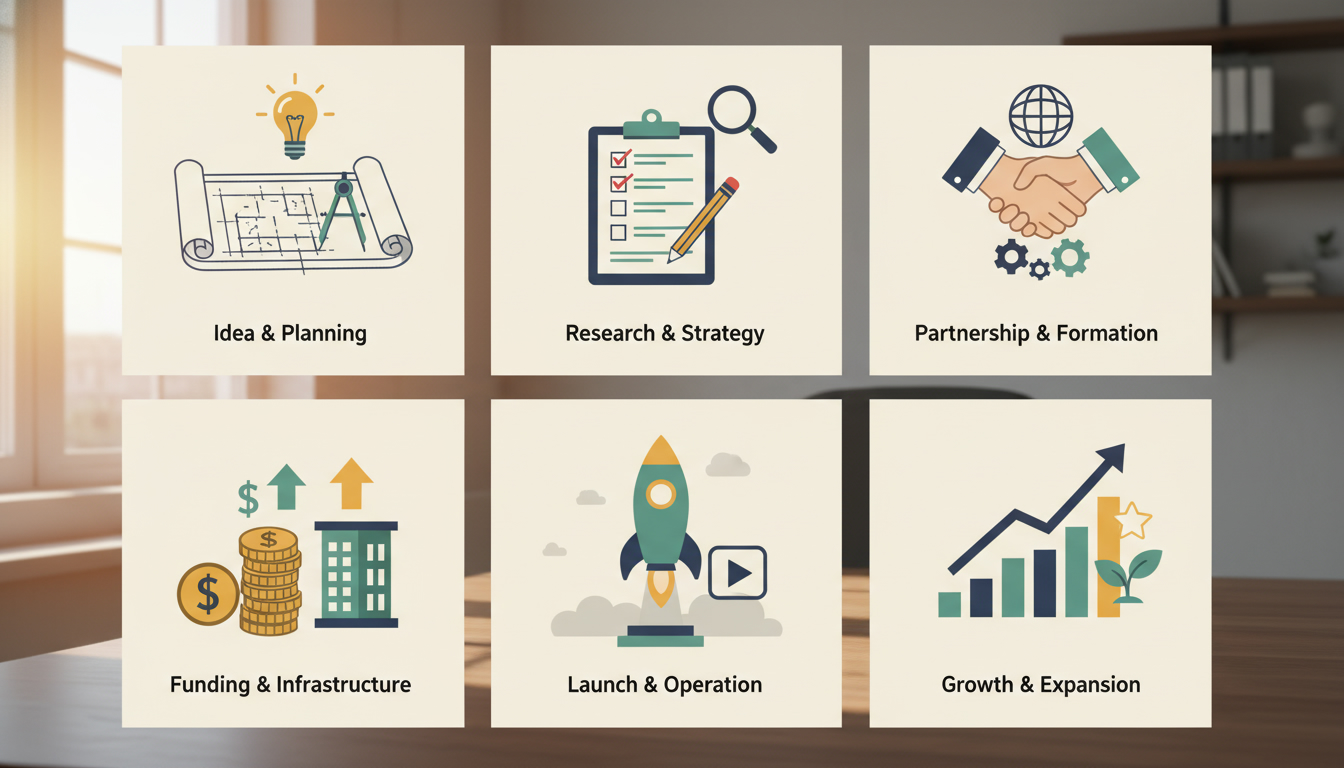
In short, what you will discover in this article: a clear and structured guide to business creation steps, from validating your idea to the official launch. You will learn how to choose the legal status, create a business plan, complete administrative formalities, and prepare your project for a smooth success.
1. Overview of the business creation steps
Starting a business requires following a precise path, with key steps to respect to avoid mistakes. Here's a quick overview of the main phases:
- Find and validate your idea
- Build the business model
- Write the business plan and financial forecast
- Choose the legal status
- Finance the business creation
- Complete administrative formalities and register the business
- Ensure protection and compliance
- Organize the activity with the right tools
- Hire or outsource according to needs
- Launch and manage the first months
This path guides you step by step, integrating administrative procedures, tax obligations management, and practical advice to not forget anything.
2. Step 1 — Find and validate your idea
2.1 Market analysis and opportunity identification
Before starting, it is essential to test your project's viability. Conduct a market study to understand demand, competition, and unmet needs. This analysis will help you identify opportunities and avoid pitfalls.
2.2 Defining the persona and value proposition
Precisely define your ideal customer (persona) and what makes your offer unique. This clear value proposition will serve as the basis for the next steps, especially for the business plan and communication.
To deepen your reflection on your idea, you can consult our complete guide on starting your business idea.
3. Step 2 — Build the business model
3.1 Revenue sources and pricing strategy
Determine how your business will generate income: direct sales, subscriptions, services, etc. Set a pricing strategy adapted to your market and clientele.
3.2 Cost estimation and break-even point
List all fixed and variable costs related to your activity, such as equipment, premises, or social charges. Calculate your break-even point to know from which turnover you start to be profitable.
4. Step 3 — Write the business plan and financial forecast
4.1 Simple financial model (3 to 5 years) and key tables
The business plan formalizes your project and reassures financial partners. It should include a financial forecast over 3 to 5 years, with a cash flow statement, a forecasted income statement, and a simplified balance sheet.
5. Step 4 — Choose the legal status
5.1 Practical comparison (micro-entreprise, EI, EURL, SARL, SAS, SASU)
Choosing the legal status is a crucial step. Here is a summary table of the main forms suited for manual trades:
| Status | Simplicity | Liability | Taxation | Suitable for |
|---|---|---|---|---|
| Micro-entreprise | Very simple | Limited | Simplified personal income tax | Beginners, light activity |
| EI (Individual Business) | Simple | Unlimited | IR or option IS | Artisan activity |
| EURL | Medium | Limited | IR or IS | Sole entrepreneur |
| SARL | Medium | Limited | IR or IS | Multiple partners |
| SAS/SASU | Complex | Limited | IS | Flexibility, investors |
5.2 Fiscal and social advantages/disadvantages by status
Each status has specifics regarding social contributions, taxation, and formalities. For example, the micro-enterprise offers simplified management but limits turnover, while the SAS allows great flexibility but requires more formalities.
6. Step 5 — Financing
6.1 Financing options (love money, loans, investors, grants)
Several options exist to finance the business creation:
- Personal contributions or love money
- Classic or guaranteed bank loans
- Private investors or business angels
- Grants and public aid
6.2 Prepare a convincing financing file
A solid file includes a clear business plan, a realistic financial forecast, and a professional presentation. It must demonstrate the viability and profitability of your project.
7. Step 6 — Administrative formalities and registration
7.1 Required documents and step-by-step procedure (online or in person)
Formalities include drafting the statutes, declaring the activity, publishing a legal notice, and registering with the Trade and Companies Register (RCS) or the Trades Directory (RM). Everything is now done via the INPI single desk, greatly simplifying procedures.
Here are the main steps to follow:
- Draft the company statutes
- Open a professional bank account
- Publish the legal notice in an authorized journal
- Fill out the activity declaration form
- Submit the complete file to the single desk
For detailed support on business creation formalities, you can consult the official guide on Service Public Entreprendre.
8. Step 7 — Protection and compliance
8.1 Insurance, intellectual property, tax and social obligations
Protect your business with suitable insurance (professional liability, ten-year insurance for construction, etc.). Also consider protecting your brand or patent if necessary. Finally, comply with your tax and social obligations to avoid penalties.
9. Step 8 — Operational organization and tools
9.1 Accounting, invoicing, recommended management and CRM tools
Set up an efficient organization with appropriate tools:
- Simple and compliant accounting software
- Automated invoicing solutions
- CRM to manage your clients and prospects
These tools facilitate daily management and ensure tax compliance.
10. Step 9 — Hiring and outsourcing
10.1 When to hire vs outsource (freelancers, providers)
Depending on your activity and growth, you may choose to hire staff or outsource certain tasks (accounting, communication, etc.). Outsourcing is often more flexible and less costly initially.
11. Step 10 — Launch and first months
11.1 Communication plan, KPI monitoring and optimization
To succeed in the launch, develop a targeted communication plan. Track your key performance indicators (KPIs) to adjust your strategy and optimize your development.
12. Practical resources
12.1 Downloadable templates (statutes, business plan, forecast, checklists)
To help you, download ready-to-use templates of statutes, business plan, financial forecast, and procedure checklists. These resources simplify creation and help you avoid forgetting important steps.
13. Conclusion
Starting your business may seem complex, but by following these business creation steps in order, you advance confidently toward your goal. Do not hesitate to use the available resources and get support to gain confidence. To deepen your project, discover how to start your business idea and immediately incorporate best practices for success.
To go further, also consider adopting eco-friendly gestures in business to make your activity sustainable and responsible.
For local and inspiring support, discover the Actipole Bugey Sud entrepreneurial hub.
Finally, for a complete and official guide, the CCI Nice Côte d'Azur offers a structured path of the steps to follow in 2025, very useful to properly frame your project (source CCI Nice).

Nicolas Joly
Ancien artisan devenu consultant en création d'entreprise dans le secteur manuel, je mets plus de quinze ans d'expérience au service des futurs entrepreneurs du bâtiment et des métiers physiques. Mon parcours m'a permis d'accompagner des profils très variés, du néophyte au professionnel en reconversion, en démystifiant les étapes clés de la création d'activité. Je partage ici des conseils pragmatiques et accessibles pour guider chacun dans le choix de son statut, la gestion administrative et la recherche de ses premiers clients. Mon objectif est d'aider les porteurs de projets à franchir le cap avec sérénité et confiance, en rendant l'entrepreneuriat concret et abordable.